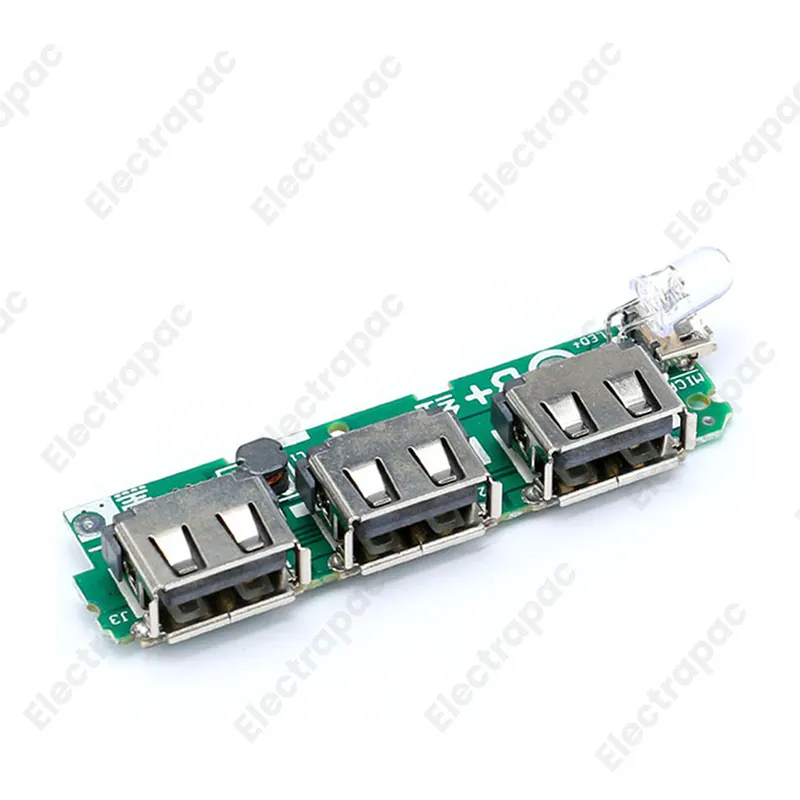
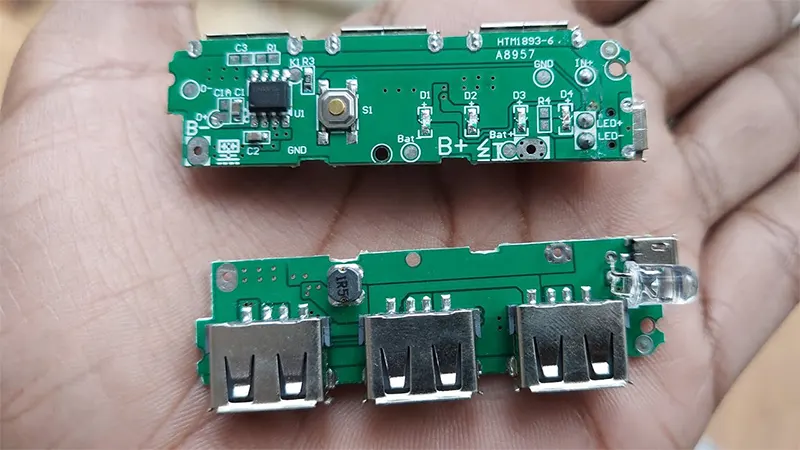
The 3 USB Portable Power Bank Circuit Board is the perfect motherboard for creating a high-performance DIY portable charger. Designed to handle multiple devices at once, this compact module offers a stable and efficient power solution for your mobile needs. Read more
The 3-USB Portable Power Bank Circuit is a high-capacity power management module designed for DIY enthusiasts who want to build their own multi-device charging stations. At Electrapac, we recommend this board for projects using multiple 18650 lithium cells in parallel to create a high-performance portable charger.
This module features a sophisticated "All-in-One" design, integrating a Lithium Battery Charger, a Synchronous Boost Converter, and a Digital LCD Status Display. Unlike standard single-port modules, this board provides three USB-A output ports, allowing you to charge a smartphone, a tablet, and a third accessory (like Bluetooth headphones) simultaneously from a single 3.7V battery bank.
Triple Device Charging: Equipped with three independent USB output ports, making it ideal for shared power banks or multi-gadget users.
Intelligent LCD Display: The backlit screen provides real-time data, showing the Battery Percentage (0-100%) and indicating which output ports are currently active ("OUT") or if the bank is "IN" (charging).
Smart Power Management: Automatically detects when a device is plugged in to start charging and shuts down after 30 seconds of inactivity to preserve your Electrapac battery life.
High-Efficiency Boost: Efficiently converts 3.7V battery power to a stable 5V output with minimal heat generation.
Dual LED Flashlight: Most versions of this board include two small "Torch" LEDs that can be activated by double-clicking the side button—perfect for emergency use.
To ensure your custom power bank is safe and efficient, follow these steps:
Parallel Battery Setup: You can connect 1 to 6 (or more) 18650 cells in Parallel.
Warning: Never connect batteries in Series (End-to-End). This board is designed for 3.7V input only. High voltage will destroy the IC.
Solder Points: Connect the Positive (+) lead of your battery pack to B+ and the Negative (-) lead to B-.
Activation: After soldering the batteries for the first time, you must plug a Micro-USB charger into the board to "wake" the protection circuit.
Wire Gauge: Use thick copper wire (at least 20 AWG) for the battery connections to handle the current draw without losing power to resistance.
High-Capacity DIY Power Banks: Building a 20,000mAh+ portable charger using recycled laptop batteries.
Camping Power Stations: Creating a multi-port charger for outdoor trips where several people need to charge phones.
3D-Printed Charging Hubs: Designing a custom-fit enclosure to match your aesthetic or gear.
Emergency Preparedness Kits: A reliable way to keep multiple small devices powered during a blackout.
Hobbyist Testing: A portable 5V source for testing USB-powered sensors and microcontrollers.
We source our 3-USB Power Bank Boards with high-clarity LCD screens and reinforced USB ports to withstand frequent plugging and unplugging. At
| Specifications | Descriptions |
|---|---|
| Input Port | Micro USB (5V / 2A) |
| Output Ports | 3x USB Type-A (5V / 2.1A Max Total) |
| Battery Compatibility | 3.7V Lithium (18650 or Li-Po) in Parallel |
| Display Type | Blue Backlit LCD (Percentage & Port Status) |
| Efficiency | Up to 92% (Boost Conversion) |
| Safety Features | Overcharge, Over-discharge, and Short Circuit Protection |
| Dimensions | ~65mm x 28mm |
| Package | 1 x 1 3 USB Portable Power Bank Circuit |

Subscribe to our newsletter and get early access to new arrivals, tech trends, and exclusive unboxing reviews from Electrapac.?